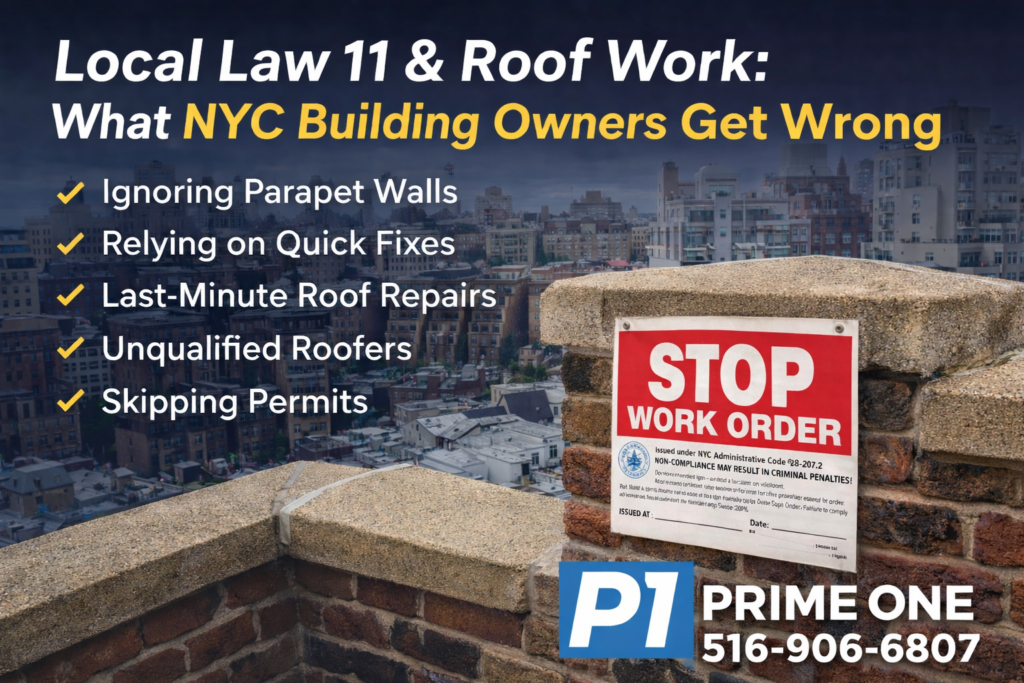
Local Law 11 (also known as the Facade Inspection & Safety Program – FISP) is one of the most misunderstood regulations in New York City. While it focuses on exterior walls, many violations, delays, and fines are directly tied to roof conditions. Unfortunately, building owners often realize this too late—after receiving violations or stop-work orders.
Below are the most common (and expensive) mistakes.
1. Thinking Local Law 11 Has Nothing to Do With the Roof
This is the #1 mistake.
While Local Law 11 is a facade law, inspectors are required to check:
- Parapet walls
- Copings and caps
- Flashings
- Roof edges and terminations
If your roof membrane, coping stones, or metal flashings are failing, your building can be marked UNSAFE or SWARMP, even if the facade itself looks fine.
Roof defects often cause facade failures, not the other way around.
2. Ignoring Parapet Walls and Coping Stones
Parapets sit right at the intersection of the roof and facade, making them a major inspection focus.
Common issues inspectors flag:
- Loose or cracked coping stones
- Deteriorated mortar joints
- Poor waterproofing beneath copings
Many owners repaint or patch instead of addressing the roofing membrane under the parapet, which leads to repeat violations.
3. Using Roofers Who Don’t Understand Local Law 11
Not all roofing contractors understand how their work affects FISP compliance.
Mistakes we often see:
- Flashings installed without proper termination bars
- Roof systems blocking facade access for inspections
- Non-code-compliant coping details
Local Law 11 requires coordination between:
- Engineers
- Facade contractors
- Roofing contractors
If your roofer isn’t familiar with DOB standards, you risk failing inspections—even after spending money.
4. Doing Temporary Repairs Instead of Long-Term Fixes
Some owners try to “get through the cycle” with:
- Roof coatings over failing membranes
- Surface-level flashing repairs
- Temporary sealants
Inspectors are trained to spot these shortcuts. Temporary fixes often lead to:
- Repeat violations
- DOB penalties
- Emergency repair orders
A properly installed roof system helps protect both the facade and your compliance status for years.
5. Waiting Until the Inspection Deadline
Roof work tied to Local Law 11 often requires:
- DOB permits
- Scaffold coordination
- Weather-dependent installation
Waiting until the last minute can result in:
- Missed filing deadlines
- Higher contractor costs
- Emergency work at premium rates
Planning roof repairs before the inspection cycle saves money and stress.
How Prime One Roofing Helps NYC Owners Stay Compliant
At Prime One Roofing, we specialize in roofing systems that support Local Law 11 compliance, including:
- Flat roof replacement & repairs
- Parapet and coping waterproofing
- Code-compliant flashing systems
- Coordination with engineers and facade contractors
We proudly serve Manhattan and Brooklyn, with deep experience in brownstones, co-ops, condos, and commercial buildings.
📞 Call Prime One Roofing at 516-906-6807 for an inspection or consultation.
Leave a Reply